
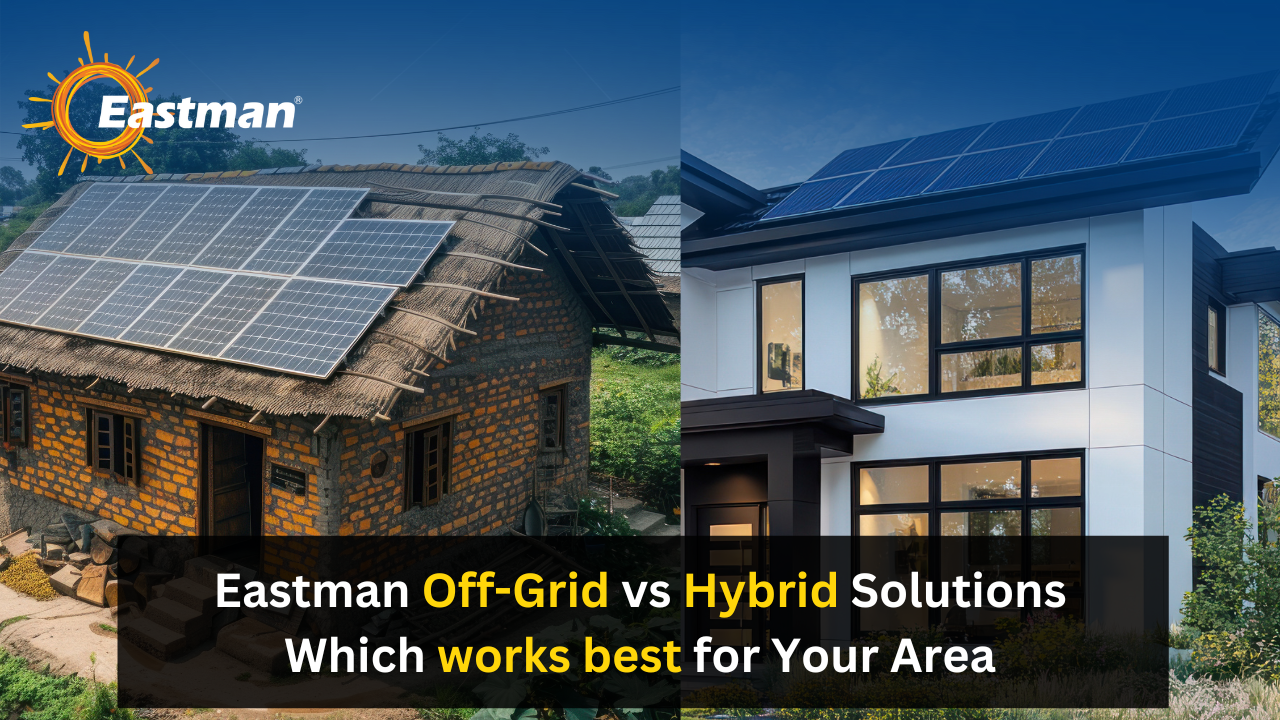

In a world embracing clean, reliable, and cost-effective energy, choosing the right solar system can be overwhelming. Whether you’re a homeowner seeking uninterrupted power or a business aiming for energy efficiency and grid savings, understanding the difference between off-grid and hybrid solar solutions is crucial.
As homeowners seek greater energy independence and financial security, the transition to solar power has become a leading strategy for future-proofing properties. At Eastman, we’re committed to powering India’s sustainable future with advanced solar technologies, designed for both residential roofs and commercial facilities. However, selecting the correct system configuration is critical to maximizing your investment. The two most prominent choices, off-grid solar systems and hybrid solar solutions, offer distinct advantages depending on your location, energy habits, and long-term goals.
This comprehensive guide compares Eastman’s advanced off-grid and hybrid solutions to help you determine which architecture aligns with your lifestyle. Whether you are looking to sever ties with the utility company completely or seeking a balance between grid reliability and self-sufficiency, understanding these systems is the first step toward a secure energy future.
Understanding Off-Grid Solutions
An off-grid solar system operates completely independently of the traditional utility grid. It relies on solar panels to generate electricity and a robust battery bank to store excess energy for use during the night or on cloudy days. Because there is no connection to the power company, the system must be sized correctly to meet 100% of the property's energy demands. It relies on solar panels, batteries, and an off-grid inverter to generate, store, and deliver electricity.
Key Components of an Off-Grid System: For an off-grid system to function reliably, high-quality components are non-negotiable. Eastman provides a suite of products designed for durability and high performance:
1. Solar Panels: High-efficiency photovoltaic (PV) modules that capture maximum sunlight.
2. Off-Grid Solar Inverter: A device that converts DC power from the panels and batteries into AC power for home appliances. Eastman’s off-grid inverters are engineered to handle high surge loads, such as starting air conditioners or pumps.
3. Deep Cycle Batteries: The heart of the system. Eastman’s Off- Grid batteries are often for their longevity and ability to withstand deep discharges, ensuring power is available when the sun isn’t shining.
4. Charge Controller: Regulates the voltage and current coming from the solar panels to the battery to prevent overcharging.
Benefits of Going Off-Grid
1. Total Energy Independence: You are immune to power outages, grid failures, and fluctuating electricity prices. This offers significant peace of mind for those prioritizing security.
2. Sustainability: It is the most eco-friendly option, as your home runs entirely on renewable energy.
3. Accessibility: Ideal for remote locations where extending the utility grid is prohibitively expensive or impossible. Eliminates recurring electricity bills, Ideal for rural areas with limited or no grid access and for locations prone to frequent blackouts.
Ideal Scenarios for Off-Grid: Off-grid systems are best suited for rural properties, cabins, or homeowners in areas with unreliable grid infrastructure. If you reside in a location prone to frequent blackouts or simply wish to eliminate monthly electricity bills entirely, an Eastman off-grid solution offers the ultimate autonomy.
Understanding Hybrid Solar Solutions
A hybrid solar system combines the best of both worlds: it remains connected to the utility grid but also includes battery storage. This allows you to store excess solar energy generated during the day for use in the evening. Crucially, if your battery runs low and solar production is insufficient, the system seamlessly pulls power from the grid as a backup. A hybrid solar system combines the benefits of grid-tie, battery backup, and solar power in one intelligent platform.
Key Components of a Hybrid System: Hybrid systems require sophisticated management to switch between power sources efficiently.
1. Hybrid Inverter: A smart inverter that manages power flow between the solar panels, the batteries, the home loads, and the utility grid.
2. Battery Storage: Like off grid but often sized differently. The battery bank in a hybrid setup provides backup during outages and optimizes self-consumption (using your own power during peak rate times). 3. Smart Meter: Measures energy imported from and exported to the grid, essential for net metering.
Benefits of Hybrid Systems
1. Reliability & Flexibility: You have multiple sources of power. If the grid goes down, your battery will take over. If the battery is empty, the grid will support you.
2. Cost Savings via Net Metering: In many areas, excess energy generated by your panels can be sent back to the grid in exchange for credits, significantly reducing your bill.
3. Optimized Energy Usage: Hybrid inverters can be programmed to use stored battery power during "peak" hours when utility rates are highest, a strategy known as peak shaving. This gives uninterrupted power during outages.
Ideal Scenarios for Hybrid: Hybrid solutions are perfect for suburban and urban homeowners and for business buildings that want to reduce their carbon footprint and electricity bills but still want the security of the grid. It is the preferred choice for those preparing for retirement who want to fix their energy costs without the strict discipline required by full off grid living.
Off-Grid vs Hybrid: A Detailed Comparison
To help you make an informed decision, we have broken down the critical differences across four key categories: cost, maintenance, reliability, and storage.
1. Initial Investment and Costs
Off-Grid: Generally, it requires a higher initial investment. Because there is no grid backup, the battery bank must be significantly larger to account for days with poor weather. The inverter and backup generator (often recommended) add to the upfront cost.
Hybrid: Typically has a lower entry cost than off grid. Since the grid acts as a backup, the battery bank can be smaller, designed to cover only critical loads during outages or evening usage.
2. Maintenance and Complexity
Off-Grid: Requires more active management. Owners must be mindful of their energy consumption to ensure they do not drain the batteries. Battery maintenance (especially if not using maintenance-free Gel or Lithium options) is crucial.
Hybrid: Offers a "set it and forget it" experience. The smart hybrid inverter automates the power flow. Maintenance is minimal, primarily involving keeping panels clean and occasional system checks.
3. Reliability and Security
Off-Grid: Reliability is entirely dependent on system sizing and weather. If the system is undersized or if there is a prolonged period of rain, you may run out of power.
Hybrid: extremely reliable. You have the security of solar, battery backup, and utility grid. This triple redundancy is often preferred by families and elderly homeowners who cannot risk power loss for health or comfort reasons.
4. Energy Storage Needs
Off-Grid: Storage is non-negotiable. Eastman’s high-capacity tubular batteries are essential here to ensure 3-5 days of autonomy.
Hybrid: Storage is flexible. You can start with a smaller battery bank and expand later if your needs change or if you wish to increase your self-sufficiency.
Which Solution is Right for Your Area
Choosing between Eastman's off-grid and hybrid solutions often comes down to your specific geography and local infrastructure.
1. Grid Stability and Availability
- Unstable Grid: If your area suffers from frequent load shedding or voltage fluctuations, an off-grid system or a hybrid system with substantial battery backup is essential to protect your appliances and ensure comfort.
- Stable Grid: If power outages are rare, a hybrid system is likely the more economic choice, allowing you to benefit from net metering policies.
2. Climate and Sunlight
- High Sun Exposure: Both systems thrive here. However, off-grid systems are easier to manage in sunny climates as the batteries recharge quickly.
- Variable Weather: In areas with long winters or frequent heavy cloud cover, a hybrid system is safer. The grid connection acts as a safety net during weeks of low solar production.
3. Local Regulations and Incentives: Some municipalities offer rebates for battery storage or favorable net metering rates for grid-tied systems. Conversely, some remote jurisdictions may have relaxed permitting off-grid structures. Always check local energy policies or consult with an Eastman partner to understand the financial incentives in your region.
4. Homes in Urban & Suburban Areas
If you’re connected to a reliable grid and want to maximize solar savings while having backup power, a hybrid solution is usually the better fit. It offers net-metering, smart energy use, and uninterrupted power during outages. Then best choice for you is Hybrid solar system with Eastman Hybrid Inverter + battery.
5. Remote or Off-Grid Locations
If grid access is unreliable, inconsistent, or unavailable, such as a farmhouse, remote facility, or off-grid resort, the off-grid system gives you total control over your power supply. Go with the best choice, i.e. Eastman Off-Grid Solar Inverter paired with proper battery storage.
Conclusion
Choosing between Eastman’s Off-Grid and Hybrid Solar Solutions depends largely on your area’s grid reliability, water needs, and long-term operational goals. Off-grid systems are ideal for remote villages with little or no electricity access, offering complete independence from the grid, zero fuel expenses, and highly reliable water pumping powered entirely by sunlight. On the other hand, hybrid solutions combine solar, battery storage, and grid power to deliver round-the-clock performance, making them perfect for regions with partial or unstable electricity where uninterrupted water supply is essential.
Both Eastman systems are engineered with durability, efficiency, and rural practicality in mind, ensuring maximum solar utilization, reduced operational costs, and long-term sustainability. With the right Eastman solution, farmers and rural communities can secure consistent water availability, boost agricultural productivity, and embrace cleaner, smarter energy for the future.
Eastman offers one of India’s most comprehensive ranges of: Solar Inverters (Off-Grid, Hybrid, Grid-Tie), Solar Batteries & Lithium Solutions, Solar Panels & Charge Controllers, Smart monitoring via Eastman One App. Our solutions ensure higher yield, unmatched reliability, and energy independence, whether you’re powering a home or a business.
Secure your Energy Future Today!
Ready to find the perfect solar configuration for your home? Whether you seek complete energy independence or smart, cost-saving hybrid power, Eastman has the perfect solar solution for you. Power your home or business the smarter way, with Eastman Solar Solutions.
- Contact Eastman for more information.
- Get to know more about Eastman’s Solar Solutions.
- Get to know your nearest Store Locator for convenience.
FAQ's
Q. Can I switch from a hybrid to an off-grid system later?
A. Yes, it is possible, but it typically requires significant upgrades. You would likely need to increase your solar panel array and significantly expand your battery bank to ensure it can handle 100% of your load without the grid.
Q. How long do Eastman solar batteries last?
A. Eastman’s high-quality deep cycle batteries are designed for longevity. Depending on the specific technology (Tubular, Gel, or Lithium) and usage patterns, they can last anywhere from 5 to 15 years. Proper maintenance and temperature control further extend their lifespan.
Q. Do hybrid inverters work during a power outage? Can they work without Batteries?
A. Standard grid-tied inverters shut down during an outage for safety reasons. However, a specific hybrid inverter with battery backup is designed to disconnect from the grid and continue powering your home using stored battery energy. Yes, they can work without batteries, but you are recommended to unlock seamless backup and better cost savings.
Q. What maintenance is required for these systems?
A. Solar panels require occasional cleaning to remove dust and debris. For batteries, if you choose maintenance-free options like Gel or Lithium, little work is required. Flooded lead-acid batteries require periodic water topping.
Q. What’s the main difference between off-grid and hybrid systems? Which system has lower maintenance?
A. Off-grid systems operate independently of the electric grid, while hybrid systems intelligently use the grid, batteries, and solar panels together. Hybrid systems generally require less maintenance due to balanced grid usage and optimized battery cycling.
Share:


related Posts


Interested in buying our products?
Fill the enquiry form or call us on:
 78728 78728