
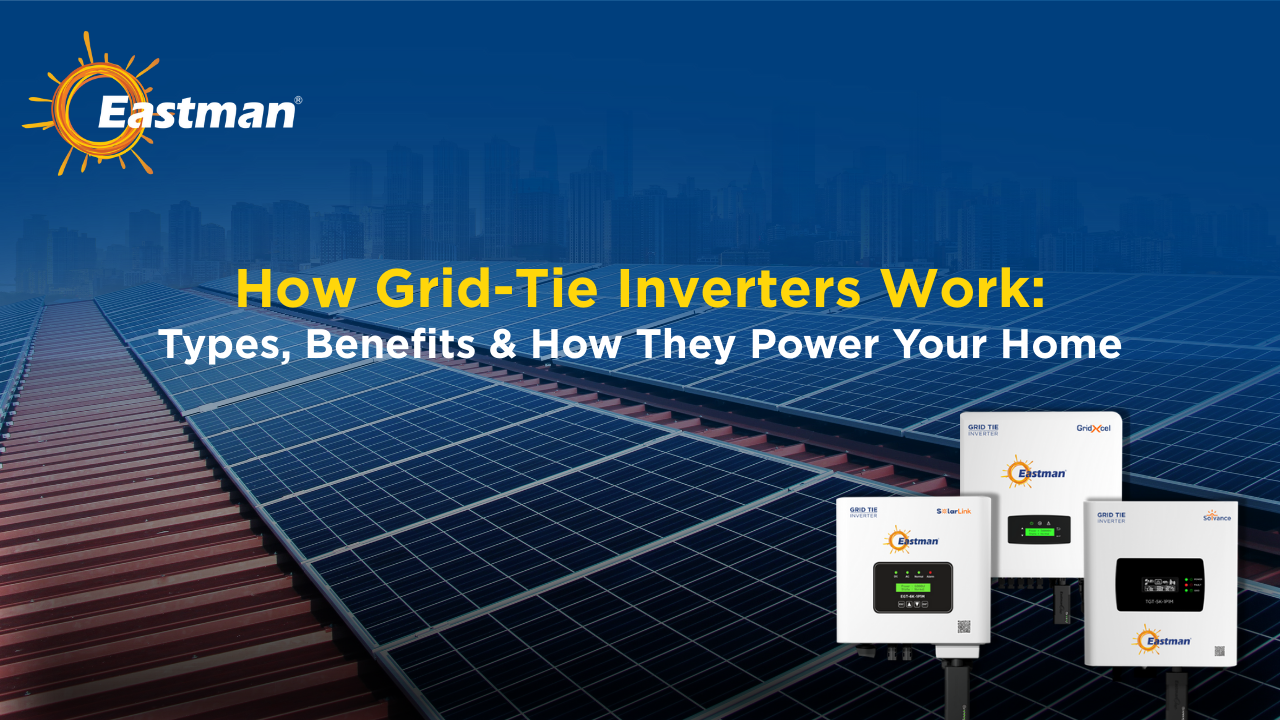

As solar power adoption accelerates across residential, commercial, and industrial sectors, one component plays a central role in connecting solar energy to everyday electricity use: the grid-tie inverter. Often considered the brain of an on-grid solar system, a grid-tie inverter ensures that power generated by solar panels is efficiently converted, synchronized, and supplied to the utility grid.
For homeowners looking to reduce electricity bills and for businesses aiming to optimize energy costs at scale, understanding how grid-tie inverters work and choosing the right one are essential.
This blog explains what grid-tie inverters are, how they work, their different types, key benefits, and why they are a cornerstone of modern solar installations. We also explore how Eastman delivers advanced grid-tie inverter solutions tailored for both residential and commercial solar projects.
What is a Grid-Tie Inverter?
A grid-tie inverter, also known as an on-grid inverter, is a device that converts direct current (DC) electricity generated by solar panels into alternating current (AC) electricity that matches the utility grid's voltage, frequency, and phase. Unlike off-grid or hybrid inverters, grid-tie inverters do not store power in batteries. Instead, they:
- Supply solar power directly to connected loads
- Export excess electricity to the utility grid
- Draw power from the grid when solar generation is insufficient
This seamless interaction with the grid makes them the most efficient and cost-effective option for locations with reliable grid access.
How Grid-Tie Inverter Works?
The operation of a grid-tie inverter can be broken down into simple steps:
1. Solar Energy Generation: Solar panels generate DC electricity when exposed to sunlight.
2. DC to AC Conversion: The grid-tie inverter converts DC power into grid-compatible AC power.
3. Grid Synchronization: The inverter synchronizes output voltage, frequency, and phase with the utility grid to ensure safe power export.
4. Power Distribution: Solar power is first used by on-site loads, then excess power is exported to the grid, and when solar output drops, power is automatically drawn from the grid
5. Safety Shutdown: In case of grid failure, the inverter shuts down automatically (anti-islanding protection) to ensure safety for utility workers.
This intelligent flow ensures maximum solar utilization without compromising grid safety.
Types of Grid-Tie Inverter
Choosing the right grid-tie inverter depends on system size, installation type, and performance requirements. The main types include:
1. Single-Phase Grid-Tie Inverters: Designed for residential and small commercial applications, these inverters are ideal for:
- Homes
- Small offices
- Shops and clinics
They typically support lower capacities and are easy to install and maintain.
2. Three-Phase Grid-Tie Inverters: Used in commercial and industrial installations, three-phase inverters handle:
- Higher power capacities
- Balanced load distribution
- Better performance for heavy equipment
They are common in factories, malls, institutions, and large commercial buildings.
3. String Inverters: These are the most widely used grid-tie inverters. Solar panels are connected in strings, and each string feeds the inverter. They offer:
- High efficiency
- Cost-effective design
- Simple maintenance
4. Smart Grid-Tie Inverters: Modern grid-tie inverters include advanced features such as:
- Remote monitoring
- Communication interfaces
- Smart export control
- Performance analytics
These features enable users to track system performance in real time and optimize energy usage.
Key Benefits of Grid-Tie Inverters
1. Maximum Energy Efficiency: Grid-tie systems eliminate battery losses, ensuring higher system efficiency compared to off-grid solutions.
2. Lower System Cost: Without batteries, installation and maintenance costs are significantly reduced.
3. Reduced Electricity Bills: Solar energy directly offset grid consumption, leading to substantial savings over time.
4. Net Metering Advantage: Excess solar power can be exported to the grid, earning credits through net metering policies (where applicable).
5. Environmentally Friendly: Grid-tie systems promote clean energy adoption and reduce dependence on fossil fuels.
Why Grid-Tie inverters are critical to modern solar systems
As solar policies, grid infrastructure, and smart energy management evolve, grid-tie inverters act as the interface between renewable energy and conventional power systems. They enable decentralized power generation while maintaining grid stability, making them indispensable to future energy ecosystems. Grid-tie inverters are suitable for modern residential and commercial applications as follows:
Residential Applications
- Ideal for homes with stable grid access
- Lower electricity bills
- Compact and silent operation
- Easy rooftop installation
Commercial & Industrial Applications
- Supports high-capacity solar plants
- Reduces peak demand charges
- Improves sustainability credentials
- Enables large-scale energy cost optimization
Why Eastman Grid-Tie inverters Stand Out
With a strong presence in solar power electronics, Eastman offers a comprehensive range of grid-tie inverters for residential, commercial, and industrial use. Eastman’s grid-tie range includes:
- SolarLink Series – Designed for residential and small commercial use.
- GridXcel Series – High-efficiency solutions for commercial and industrial applications.
- Solvance Series – Compact, reliable inverters with advanced safety and monitoring features.
Key Features:
- Wide power range (from 3-110 kw)
- High conversion efficiency
- IP65 protection for outdoor installation
- Built-in surge protection (AC & DC)
- Smart monitoring and communication interfaces
- Robust design with long warranty support
- 10 years of warranty
- Zero export function
- Backward integration for critical components
- We manufacture In- House and are proudly Made in India
- Real-time monitoring option through the Eastman One App
These features ensure reliability, performance, and long-term value, making Eastman a trusted choice for solar technicians, installers, and end users.
Conclusion
Grid-tie inverters are the backbone of efficient, cost-effective, and scalable solar power systems. By enabling seamless interaction between solar panels and the utility grid, they allow users to maximize solar generation, reduce electricity bills, and contribute to a cleaner energy future.
With advancements in efficiency, safety, and smart monitoring, modern grid-tie inverters are more reliable than ever. Backed by strong engineering, a wide product range, and proven performance, Eastman continues to deliver grid-tie inverter solutions that meet the evolving needs of residential and commercial solar users.
Explore Eastman’s Grid-Tie Inverter Range; engineered for performance, safety, and long-term savings.
- Contact Eastman for more information.
- Explore Eastman Grid-Tie Solutions.
- Get to know your nearest Store Locator for convenience.
FAQ’s
Q. What is the main difference between grid-tie and off-grid inverters?
A. Grid-tie inverters work with the utility grid and do not use batteries, while off-grid inverters operate independently with battery storage.
Q. Do grid-tie inverters work during power outages?
A. No. For safety reasons, they shut down when the grid fails.
Q. Are grid-tie inverters suitable for homes?
A. Yes. They are ideal for homes with stable grid access and net metering.
Q. Can grid-tie inverters be installed outdoors?
A. Yes. Models with IP65 protection are designed for outdoor installations.
Q. How long do grid-tie inverters last?
A. Typically, 10–15 years, depending on usage and environmental conditions.
Share:


related Posts


Interested in buying our products?
Fill the enquiry form or call us on:
 78728 78728